
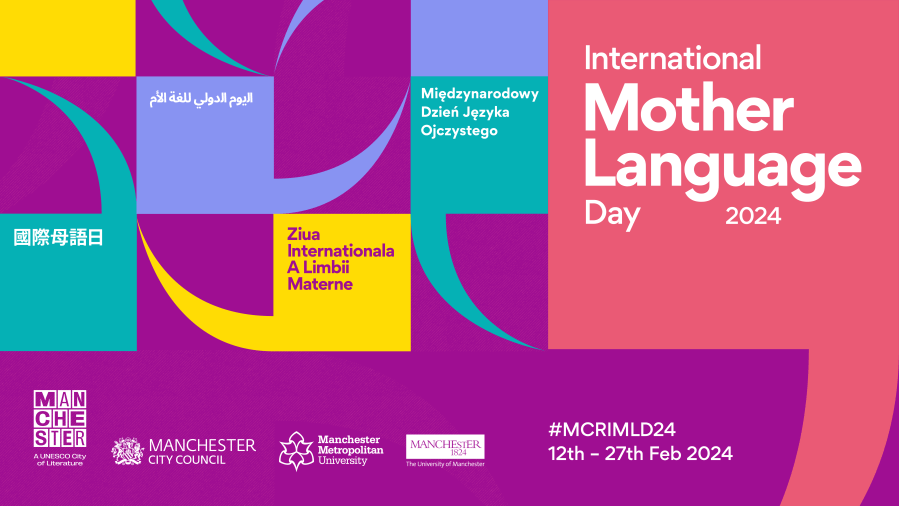
Celebrating UNESCO International Mother (and Father) Language Day 2024
This online conference with international participants will take place on Wednesday 21 February 2024 at 4-6.30pm UK time.
Registration through Eventbrite:
The conference will feature discussion panels on language teaching, indigenous language rights and the role of language in UNESCO cities of culture. Panellists will include language teachers, language activists and UNESCO city of literature executives. Participants will have the opportunity to rotate between discussion panels in different break away rooms. For a description of the panels see below.
The conference aims to compare experiences and reflect on how to interrogate language hierarchies in teaching, activism for policy and social change, and cultural events. We will explore how knowledge can lead to action, what we want for languages in cities, and what we envisage as a ‘multilingual utopia’.
The conference is organised jointly by Manchester City of Languages, the Aston Centre for Applied Linguistics in Birmingham, Manchester City of Literature and MACFEST (Muslim Arts and Culture Festival) International.
Upon registration you will be asked to specify your preference for two of the three break-away rooms:
Room 1: Teaching languages: How do we dismantle language hierarchies?
We wish to compare experiences and reflect on the advantages and disadvantages of the current arrangement for teaching, where home languages are viewed as ‘heritage’ and so-called modern languages are considered ‘skills’, and to discuss possible alternative visions that value languages equally. Panellists will include teachers of home languages who work at community and privately run supplementary schools, and teachers of languages that are part of the curriculum of mainstream state schools.
Room 2: ‘Language in UNESCO network cities’
UNESCO cities of Literature have an ambitious programme of engaging the public with culture through creative literacy, with special consideration to poetry and often also creative writing and translation in lesser known and lesser supported languages. Manchester has adopted UNESCO International Mother Language Day into its official civic calendar and has advocated similar work in other cities. Our cities have various language profiles and provisions. We will compare our experiences and possibilities to engage with multilingualism as an emblem of civic identity. Panellists include representatives of three UNESCO Cities of Literature: Manchester, Leeuwarden and Gothenburg.
Room 3: Promoting disadvantaged languages
Users of countless smaller and disadvantaged languages around the world struggle to secure provisions to use their languages in public domains, sustain creativity in their language, and often even transmit it to next generations. Many of the world’s languages are considered endangered. Our panellists include activists for the promotion of disadvantaged languages. We ask how institutions and individuals can make a contribution to strengthening and sustaining languages drawing on research, policy initiatives and social media.
For further information contact:


 City of Languages
You must be logged in to post a comment.