

Manchester’s language diversity has received wide public attention and has earned it the title of one of the most linguistically diverse cities in the country and beyond. The city’s multilingualism has also been featured in international reports in French, Hungarian, Croatian, Swedish, Italian, Slovenian, Catalan, Indonesian, and many more.

Statistics
In the 2021 Census around 18 per cent of the city’s residents declared a language other than English as their ‘main language’, up from 16.6 per cent in 2011 and around twice the average for England and Wales.
The most widely named ‘main languages’ were Urdu (ca. 17,500), Arabic (ca. 10,400), Chinese (ca. 8,000), and Polish (ca. 6,500). Panjabi and Spanish each had between 4,000-4,500, Portuguese and Italian around 3,000, and Somali, Kurdish, Persian (Farsi) and French between 2,000-2,500. The census identified more than 90 languages that are spoken by residents as a ‘main language’.
Many more people use other languages in their daily lives. More than half of Manchester’s residents are thought to be multilingual, in that they make use of more than one language on a regular basis.
School census data from 2020 showed that over 40 per cent of school pupils in the city had a ‘first language’ other than English. Many more use additional languages at home but are not covered by the census.
Urdu and Arabic as the most widespread languages spoken by school pupils, followed by Somali, Bengali and Panjabi, Italian, Spanish, and Polish. The School Census for 2020 named over 180 different languages.
Around 45 Manchester schools identify more than 30 different first languages.
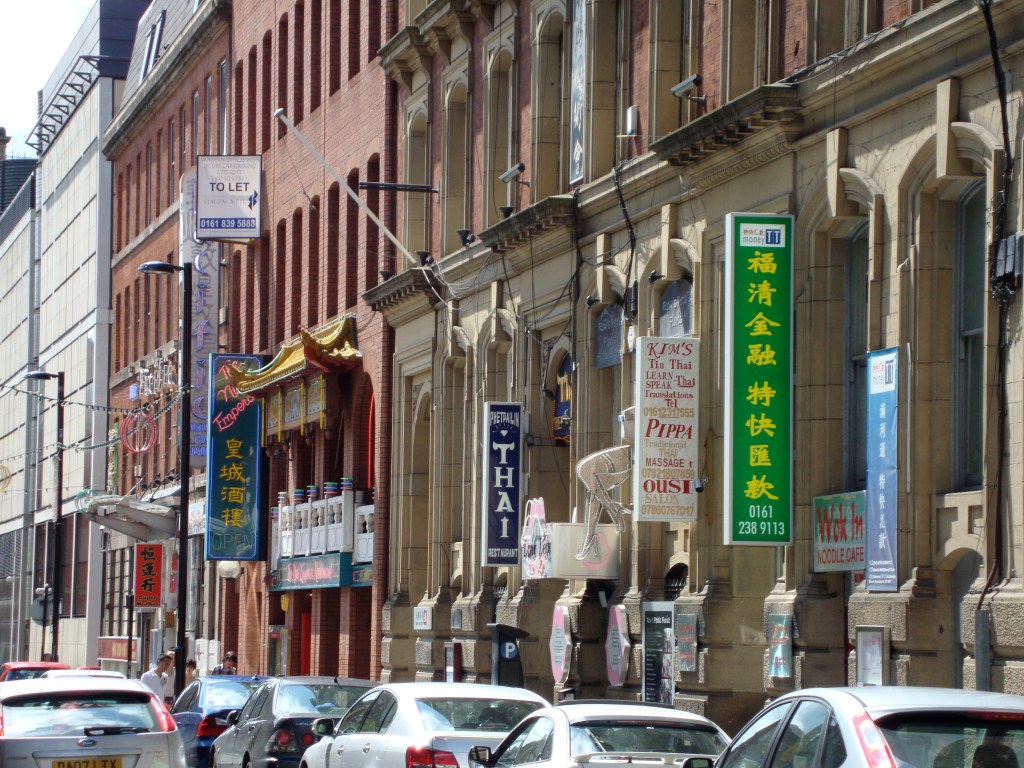
Over 50 languages are represented in the city’s public spaces on signs of local businesses and cultural and religious institutions, adverts and noticeboards, landmarks, parks, health and safety notices. The most frequently found languages on public signs are Arabic, Chinese, Polish, Urdu, Bengali, Persian, Sorani Kurdish, Somali, Hebrew, Turkish and Panjabi.
Why are languages important
Languages are part of our identities. They give us a sense of belonging that connects us with our families’ histories and past, with cultural heritage, and with the communities of people with whom we interact both locally and in other places. Languages shape our experiences and the way we approach ideas and modes of behaviour. They give us flexibility and open up new ways of conceptualising the world, and help us build bridges to other societies. Languages are who we are. To be able to navigate several languages is a privilege. To have one’s language acknowledged and supported is a human right. To recognise and explore the languages that are spoken in our community and locality is a joy, a source of pride, and a duty if we are committed to equal opportunities and respect for all.

Celebrating multilingualism
Manchester has taken a substantial step toward recognising the richness of its multilingual heritage, by releasing a policy report on language diversity, by branding itself as ‘City of Languages’ and celebrating its language diversity through initiatives such as the ‘Made in Manchester’ multilingual community poem. In 2018, the city adopted UNESCO’s International Mother Language Day as an official, annual city-wide celebration, following the introduction in 2015 and 2017 of Levenshulme Language Day by Multilingual Manchester and local partners in community groups and libraries. Manchester has since developed its unique and distinctive history of language celebrations. Manchester’s Multilingual City Poets have been promoting appreciation and celebration of the city’s languages through their artistic creative work, working with people of different communities and age groups through schools and festivals. Manchester Poetry Library offers a venue and resources for poetry in the city’s languages and support a multilingual poets group. The Mother Tongue Other Tongue annual poetry competition offers school pupils opportunities to showcase forms of language that play a role in their lives.
More about the city’s languages
Languages other than English with large numbers of speakers in Manchester include Urdu, Chinese, Arabic, Polish, Panjabi, Bengali, Somali, Persian, and Kurdish. French and Portuguese are widespread among communities of both African and European origins. Greater Manchester has the country’s highest speaker concentrations outside of London for a number of languages including Yiddish, Somali, Kurdish, and Romani. There are long established speaker communities of languages from different parts of the world, including African languages such as Yoruba, Shona, Akan, Nigerian Pidgin English, Hausa, Swahili and Tigrinya, Caribbean languages such as Jamaican Patwa, eastern European languages such as Slovak, Czech, Lithuanian, Latvian, Ukrainian, Romanian and Hungarian, western European languages including German, Spanish and Greek, West Asian languages including Turkish, Armenian, Dari and Pashto, South Asian languages such as Gujarati, Telugu, Malayalam and Tamil and regional languages such as Sylheti and Pahari, and East Asian languages including Korean, Vietnamese, Malay and Thai. Various languages are used by Manchester residents for liturgical purposes and religious study, among them Classical Arabic, Sanskrit, Biblical Hebrew, Biblical Greek, Armenian and Panjabi. Around 800 Manchester residents declared British Sign language (BSL) to be their ‘main language’ on the 2011 Census.

Spatial distribution
City wards with high language diversity, where over 20% of residents declare a ‘main language’ other than English, include Ardwick, Cheetham, City Centre, Crumpsall, Gorton South, Harpurhey, Hulme, Longsight, Moss Side, Rusholme, and Whalley Range, each showing at least 50 different languages and often many more.
Wards with a high percentage of school pupils for whom a ‘first language’ other than English is identified include Ardwick, Cheetham, Longsight, Moss Side, and Rusholme (each over 60%), as well as Burnage, Crumpsall, Fallowfield, Gorton South, Hulme, Levenshulme, Old Moat, and Whalley Range (each over 40%). In over 20 Manchester schools, EAL (English as Additional Language) pupils make up more than 70% of the school population. The most frequent languages include Urdu, Arabic, Somali, Panjabi, Bengali, Polish, French, Yoruba, Portuguese, Chinese, Pashto and Kurdish. The School Language Survey, piloted by the University of Manchester in 2013 among 530 children in four Manchester schools, showed that many children speak more than one language in addition to English and that therefore the term ‘first language’ does not always capture the reality of family multilingualism. The survey also showed that children who had a strong command of one or more of their home languages also had high proficiency in English, and thus that maintaining another home language supports rather than obstructs acquisition of English.
Language provisions
The city hosts a variety of language provisions. Manchester libraries stock over 25,000 titles in more than 20 languages other than English, with a high volume of stock for Urdu and Chinese as well as for Polish, Bengali, Arabic and Vietnamese.
The city council’s translation and interpreting service M-Four Translations has a number of permanent staff members as well as freelance vendors who respond annually to over 10,000 requests for interpreting and translation in more than 70 different languages.
Manchester’s health care sector has one of the most advanced system of language support of any health care system in the world. Although only 0.5 per cent of the city’s population reported that they are unable to speak English, Manchester’s hospitals and primary care outlets provide access to professional interpreters for over 100 languages in order to ensure that language barriers do not interfere with quality of care or equal access to care and health information.
Language courses are offered by a number of cultural institutions in the city including Alliance Française, Instituto Cervantes, and Goethe Institute and some of the city’s higher, adult and further education institutions.
Manchester Deaf Centre supports the needs of the city’s deaf population and offers courses in British Sign Language.
A large number of supplementary schools operate at weekends and evenings, often led by volunteers, to help young people cultivate, learn and gain qualifications in over 50 heritage or community languages including Chinese, Arabic, Polish, Bengali, Panjabi, Persian (Farsi), Kurdish, French, Greek, German, Ukrainian, and many more.
Religious institutions offer pupils of Muslim, Jewish, Sikh and other backgrounds literacy instruction in Quranic Arabic, Biblical Hebrew and Yiddish, and Classical Panjabi, respectively.
Language skills
Research shows that far from discouraging new arrivals from learning English, effective provisions for interpreting and translation help build confidence in public services and motivate people to learn English.
The language skills of Manchester’s workforce have been identified by Manchester’s investment agency MIDAS as among the top five factors that attract international businesses to invest in the city. Business initiatives such as the China Forum and the Middle Eastern Consortium draw on the city’s cultural and linguistic links to particular regions of the world.
Manchester is home to many businesses that specialise in international customer services and which rely on staff language skills. At any given time, several dozen jobs (in addition to interpreters and language teachers) are being advertised within a 15 mile radius of Manchester city centre that require foreign language skills, in areas such as marketing, customer care, and information technology.
Support for English for Speakers of Other Languages (ESOL) is provided by the city council’s adult education services MAES, through a series of programmes as well as by private and voluntary sector initiatives. Manchester continues to attract new arrivals from different parts of the world, many of whom are highly skilled but require English language support to ensure integration into the professional work force.
 City of Languages
You must be logged in to post a comment.